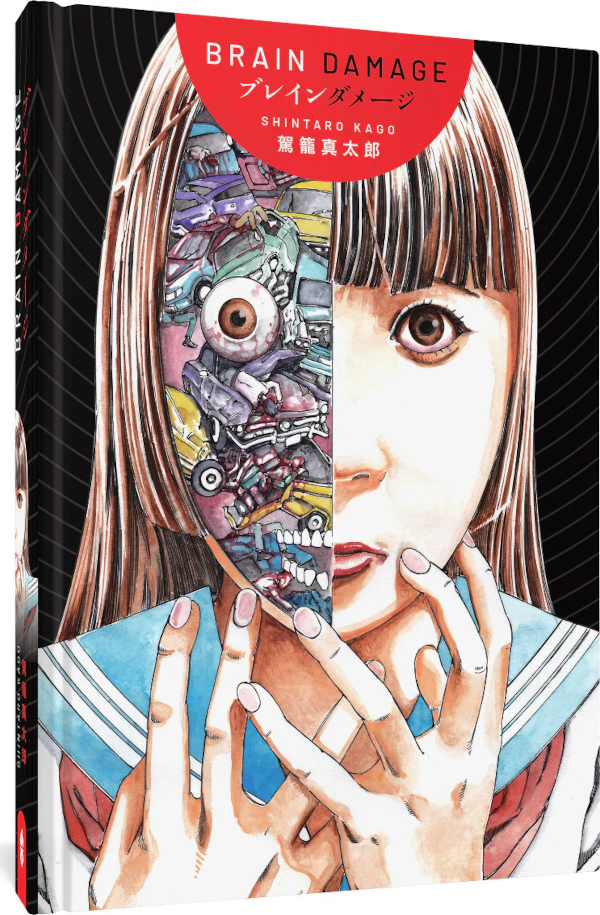
Kago’s collection of four stories are strange and quirky and occasionally repulsive. While they explore some interesting concepts in novel ways, it is hard to recommend the collection without a couple of caveats.
Synopsis
(excerpted from Fantagraphic’s official item page for Brain Damage): From the brilliant and twisted mind of manga artist Shintaro Kago, a new collection of short stories rife with skin-crawling suspense, visceral body horror, and pitch dark-humor. Brain Damage collects four new short manga stories, a tantalizing blend of the hilarious and the macabre. In “Labyrinth Quartet,” four identical young women trapped in an eerie building must solve the mystery of why they’ve been gathered there — while being hunted by a knife-wielding stalker. In “Curse Room,” a plucky health aide is tasked with keeping zombies peaceful, lest they go on a brain-eating rampage. In “Family Portrait,” people throughout town are strangely disappearing without a trace, and the key to it all is a senile and perverted old man. Finally, in “Blood Harvest” a series of gruesomely mangled bodies are found in pristine cars — and it appears something sinister lurks within these masses of glass and steel.
Content Warnings [mild spoilers]
There is quite a bit of gore and violence as is expected for a horror manga. “Family Portrait” includes incest and sexual assault against a teenager. That story also a few panels that might trigger trypophobes. To a much lesser degree, there are a few panels showing nudity and some with smoking. I doubt those will bother people as much but just in case.
Review [spoilers obfuscated]
After I finished reading Brain Damage last night, I realized that the only story I liked without qualification was the first: “Labyrinth Quartet.” It takes the trope of “strangers wake up in a strange structure” and progresses through it quite nicely to an ending that had a nice punch. Four young women who look a lot alike find themselves being hunted by a strange, masked killer. As they flee, they find evidence that things are even more odd than they expected.
I enjoy that it broaches upon the meta — UpcIh y 9QsOk Uk y NsOOsO MyIhyly yUsqQ lcXXcIh sFF PNyOyPQpO9 QNyQ Xssl yXclp Qs Mylp y hOqp9sMp NsOOsO MyIhy — and that it does not bother itself too much with explaining how it makes little sense.
It set up the book for high hopes. Hopes that never quite came to fruition.
The second story, “Cursed Room,” also started quite strong. A young woman feels her apartment is haunted. Only, a few pages in [and note I am “spoiling” this because the book spoils it], we learn that she is actually an undead person who is on the cusp of turning into a flesh-eating creature. In this world, though, some “returners” retain their humanity for a bit of time.
The story progresses along with the mechanics of trying to convince the dead to wish for death and, being a horror story, eventually goes further off the rails. This one’s primary demerit is the the final page where it abruptly shifts and left me confused. I was unsure which of two possibilities it was showing, and perhaps the confusion is the point:
(1) s Q007ib wRb b15C1j CiTBCb0 wRQw wRb wbtR1CK7b0 A1Bv wQ7jRw wRb rbw7r1br/JAiMCb0 wA biMrQtb wRbCr b13Avib1w Ay yBb0R.
(2) kTvQaT M0 DrrBd BMhr M0 bvQBR Tmfr Prr3 dmyM3a 0Tm0 0Tr EvjPMrd Fr1r 0Tr v3rd FTv 1Q33M3a m DmbMBM0y m3R Fr1r bv3fM3bM3a TQjm3d M30v m RrBQdMv3 vD 0TM3hM3a 0Try Fr1r TrB6M3a Py vDDr1M3a 0TrjdrBfrd Q6 md DvvR.
The third story was one of the highs and lows of the collection. “Family Portrait” takes a definite issue that happens when people deal with dementia and senility, the sexual advances towards family members, and begins strongly [minus the younger brother blaming the sister which felt weird]. We see the contrast between the teenage granddaughter’s stress of dealing with this challenging behavior and the way the local people have fond memories of the grandfather.
And that works, right? That encapsulates one of the core struggles of dealing with caretaking. You experience someone at their worst but also know they are someone who has a long and loving history. There’s a reason that caretaker burnout is such a thing.
Then, as people begin to disappear, the reader appreciates the metaphor between the two losses of self: the loss of the good person the grandfather used to be vs the disappearance of people in the neighborhood. All this is mostly to the good.
Kago decides to just go full in to the grotesque he writes and illustrates an extended sequence 9Z1J1 zZ1 wJCGIICfwZz1J D771Js Z1Js1V7 fO 7DJ s1afCV CEfs1 E2 zZ1 wJCGI7CzZ1J zD zJ2 CGI szC2 MG ZMs 818DJ2, MG0VfIMGw 7fVV DG 8DV1szCzMDG CGI sD81 tf1szMDGCEV1 IMCVDwf1 0ZDM01s.
Even as powerful as the final page for this one is, one of the most haunting scenes in the whole book, the build up to it feels unnecessary since horror was already there.
By contrast, the final story, “Blood Harvest,” is almost tame. Two friends on the way back from a fun-day outing are caught in traffic and one of the friends is brutally mutilated without any obvious cause. As the surviving friend gets caught up trying to make sense of the situation, she realizes that other people have died in similar circumstances.
With a degree of mysticism and some of the best drawn gore in the collection, this one holds mostly true. The plot twist makes puts me in mind of jbG’I b9H BmH bHH pQQ6 I8e1EB9, f4em cBLI NWWB1Z, but I am ok with that mostly. It feels new.
And like “Cursed Room,” the final panel shows up a bit abruptly but I feel it was better telegraphed and helps to find a whole new layer of horror in the story.
I didn’t like the twist as much as I liked “Labyrinth Quartet’s,” but it is my second favorite with “Family Portrait” so far at the bottom that it is barely included.
I’m now in a place where I am interested in reading more of Kago’s work but also kind of ok with waiting until more naturally shows up rather going out of my way to seek it out.
As for recommending it or not: maybe. If you like horror manga and like it a bit weird, it can work. Just note the warnings because at least one of them might be a heavy trigger for folks.
Just a couple of shout outs at the end: (1) Zack Davisson’s translation feels really authentic to the source and I am impressed and (2) Fantagraphics’ printing is a nice quality.
Leave a Reply