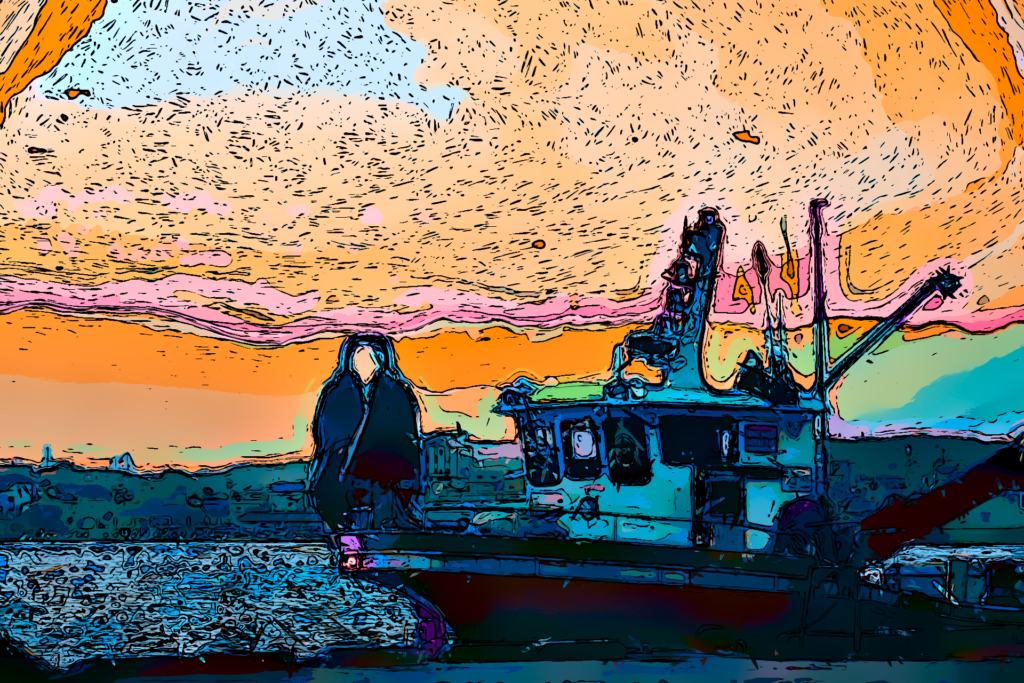
Hiroyuki is a miserable man. Miserable in his life. Miserable to be around. A fisherman, Hiroyuki is abusive to his son and his wife. Though successful in catching eels, he feels trapped by his family. One day he wakes up and his wife is gone and he feels a strange fear of getting back out on the water.
For an explanation, see 7 Days of [Koji Suzuki’s] Dark Water.
“The Hold”
Hiroyuki is good at only one thing: fishing for conger eels. That he does well. As a father, he barely cares what his son — Katsumi — wants from him. Hiroyuki provides and expects Katsumi to accept. Likewise, with his wife — Nanako — he gives her a substantial income (one million yen per month) and expects general appreciation. Otherwise he drinks and turns regularly abusive as he feels slighted and out of sorts with his life.
When he wakes one day to find Nanako gone, and no one having seen her, he struggles with the ideas of who he is and how much he is simply filling in the role handed down to him by his own father. A father that is now ridden with dementia and living with Hiroyuki. Hiroyuki and Nanako’s youngest, a daughter with aphasia, rounds out the family.
Even with the disruption to his life his absent wife brings, Hiroyuki knows his central purpose is to fish. To bring in the eels. To earn money. Only why does he feel afraid to get back out on the water?
DEEPER DIVE: “The Hold”
HERE BE SPOILERS!
NOTE: Spoilers will not obfuscated.
It is interesting that in a collection of stories that would no doubt — by the author and by general bookshop/library sorting — be identified as a horror collection, a collection of ghost stories, that “The Hold” is the first that actually has explicit horror elements. While we could arguably not have a ghost, we definitely have a death and a rotting corpse and a moment of actual dread.
The opening scene, looking out from the pavilion at Cape Futtsu, echoes the prologue by looking out over the water from a vantage point. This duality, being abstracted from the water while caught up in its currents, is common in these stories.
Likewise, as Hiroyuki contemplates how much he takes after his father while his son does and does not take after him reflects a moment from “Floating Water” [the irony of that title just occurred to me]. It is a fairly central trope of the collection: the you which you are now is only one step on a long flow of various yous in a current which also connects to ancestors and descendants. But while “Floating Water” uses the reality of generational identity as a roughly positive metaphor, though disruptive to the parental sense of self, “The Hold” posits it in a much more negative light.
Hiroyuki’s tendency to give things and expect people to react how he might react, not that he is ever quite sure, and the anger he gets when they do not follow his script show him to be a strong Yang force. He wishes to impress himself upon the world, for the world to bend to his existence, and rarely allows himself a moment for the world to flow back in except in terms of himself.
His dad’s dementia and his daughter’s aphasia are cracks in this desire. His wife’s backtalk. His son’s fear of water: a source of betrayal for a fisherman.
The biggest crack in this desperate desire for self is just how much he follows in his dad’s abusive footsteps. Like Nanako, his mom left when he was young. Now he is in a similar boat [pun kind of intended]. Trapped in his own genetic make-up, his own upbringing. His own refusal to change, to adapt.
Despite his wish to force his will upon the outside world, he fails to realize that he is living up to a false ideal of himself. He has built for himself an eel trap and filled with a bait of his own sense of victimhood that never realizes all he has to do is free himself.
Therapy would help, too. He probably needs therapy.
When he sees a father and son playing happily he primarily judges them for their clothing and their gear. He does not see what he and Katsumi could have if he simply accepted a back and forth, a shared experience. He simply sees a judgement against him. Hiroyuki’s world is Hiroyuki and Hiroyuki’s failures of manhood. Nothing else. Everything else is a punching bag or an eel. An accident between this other father and son ends up causing Katsumi pain and so Hiroyuki goes to take his frustrations about his missing wife out on them. Only Katsumi stands in between the fight, and gets thoroughly abused for it despite also missing a mom and being the one struck by a wayward ball. Coming down from his rage, Hiroyuki notes the others have fled. He has no introspection to realize it is because they did not want to witness violent child abuse. Instead, he imagines they have gone off to play with other toys.
Yes, therapy would help a lot.
There is a moment on the second day after Nanako has gone where he wakes up and demands someone make him breakfast. No one in the house — not his children or his elderly father — would be able to do such a thing better than he, himself, could do it. He barely, but does…just…register that these others might also need to be fed. That’s part of his theory-of-self. Men have food brought to them. Men drink without people complaining. Men go on furious tirades and openly physically abuse their son. Strike their wife. It’s a terrible version of masculinity.
Then we get to the boat and the actual horror part of the horror story. While “Floating Water” denied us the knowledge about whether the girl was in the tank, here we get definite proof that Nanako has been placed in the tank [something that was perhaps a bit obvious and heavily foreshadowed throughout]. The tank in this case being the hold for eels that have been caught. Hiroyuki realizes in a drunken rage he murdered her. Her biggest sin? Saying she was afraid that her son would turn out like her husband if she left. That she was staying to prevent the very cycle in which Hiroyuki feels trapped.
Hiroyuki, thinking back about his crime, realizes how much his terrible behavior is linked to this fragile sense of self, his lack of love. He starts to realize he is in a trap. It is too late for his wife but perhaps he can start caring for his son and daughter. For his father. Only he has to do something with the body.
He enters into the hold as storm is coming up and right as he is trying to physically pull the rotting, bloated body up…the boat capsizes. He is trapped in the hold with the corpse, slowly but surely losing air as the boat sinks. When he tries to make an easy escape, something catches him. A follow-up attempt has his wife’s body swim to block his exit.
This is when he realizes that his mom [maybe] didn’t abandon him all those years ago. His abusive father must have also snapped. The near-death experience of his dad must have been precursor to Hiroyuki’s own attempt to hide the evidence. It is not merely genetic but practically an echoing cycle. In the context of this story, if Hiroyuki survives he will become demented and broken and Katsumi is likely to become a third generation of failed men.
Yet he struggles to live, like his father possibly struggled to live all those years ago.
By the end of the story, Hiroyuki is dead and in an embrace with Nanako’s corpse. Perhaps the only way that Katsumi could be free from this same echo, tragically being orphaned. Whether or not Hiroyuki’s broken family can survive is not dwelt upon.
Hiroyuki did not make it. They might.