
A fairly satisfying horror story about a quick sailboat excursion brushing up against something darker. It spends little time on speculation and more on the social awkwardness of the situation, which is perhaps what makes it work so well.
For an explanation, see 7 Days of [Koji Suzuki’s] Dark Water.
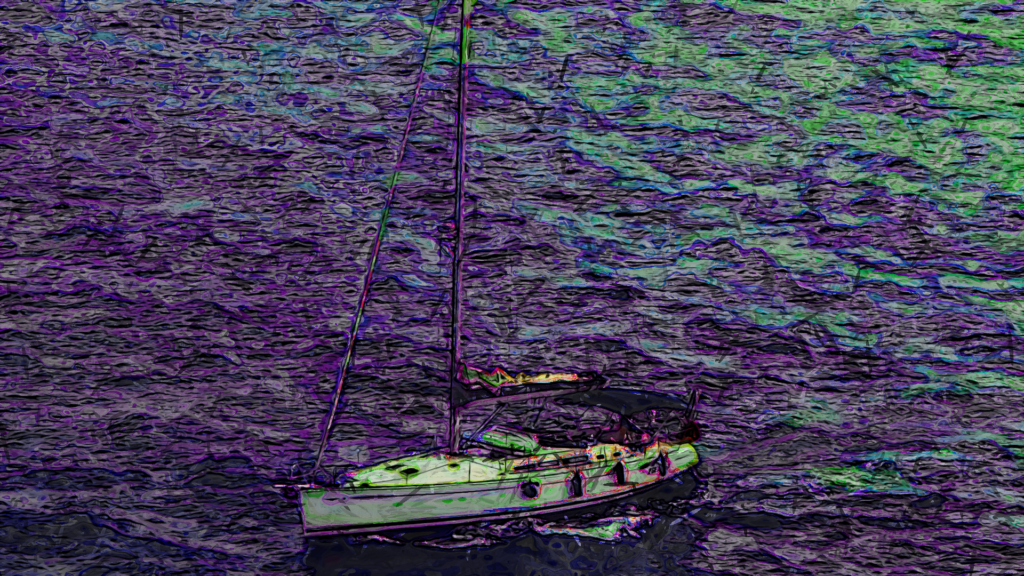
Enoyoshi [unlike some others, this one primarily uses just surnames of its two male characters] has been invited by his fellow alum Ushijima and Ushijima’s wife, Minako, to take a short sailing cruise around Tokyo Bay. They want to get Enoyoshi to sign up for their pyramid scheme while he struggles to tell them no. He just wants off the boat.
Within short distance of finishing the trip, the Minako — the boat is named after the wife — suddenly stops dead in the water. They have had to pull the sails down at the end of the ship and even clearing the motor — the blades have a small boy’s shoe trapped in them — does not help them to move forward.
Because underneath the dark water [hey yo!] of the nighttime Tokyo Bay, something seems to be holding the boat tight and only by diving into the darkness can they possible get free.
An effective short tale of social awkwardness meets unseen terrors, told from the POV of a man who simply wanted to leave. Shorter on details than the prior stories in the collection, but still strong despite this.
Deeper Dive: “Dream Cruise”
HERE BE SPOILERS!
NOTE: Spoilers will not be obfuscated.
By this story, the fourth in the collection [maybe 4.5th depending if you count the half-story of the prologue], you are fully seeing the echoes throughout the collection as a whole. The POV character notes the landfills stretching out across Tokyo Bay. He sees new buildings being constructed on these landfills, like the apartment complex in “Floating Water.”
There is also, an echo but not exact copy, a children’s object with recognizable branding as a harbinger of further horror. This time a blue boy’s shoe with Mickey Mouse instead of a red bag with Kitty.
There is also other echoes. Enoyoshi is awkwardly out of place in the situation, reflecting various degrees of Kensuke (“Solitary Isle”) and Hiroyuki (“The Hold”). His inability to just say “no” outright to the pushy Ushijimas who want to rope him into a pyramid scheme for their own profit. Like Hiroyuki, Enoyoshi sees their holding of wealth like a personal attack against himself even though, like Hiroyuki, Enoyoshi seems capable and successful in his own job [a car salesman, in this case].
There is another reference to a missing vessel. Enoyoshi is fascinated by the stories of missing ships. We had one in “Solitary Isle,” a story about a windsurfer that disappeared around the eponymous isle. In “The Hold,” there is a perhaps subtle node to the Mary Celeste in the bar’s name, “The Marie.” Of course, a long-time fisherman would have seen other boats go down or go missing, including his father’s.
A lot of the tension in the piece, before it turns to true horror is in the simple social awkwardness of dealing with pushy classmates’ get-rich-quick schemes [Ushijima is an alum from an earlier class, not a true classmate, so his older-status is part of the awkwardness]. While Enoyoshi is not trapped, per se, he might as well be by social norms. He cannot simply dive off the boat, not without good cause. He cannot effectively just refuse to talk to the couple. He is caught up in their “dream cruise” and even though he is resolute in saying “no” he is struggling with the interaction is saying about himself. He thinks a stronger person would have never set foot on the boat.
His judgement is perhaps not unwarranted, but it is also selfish. We get the earliest glimpse of this the way that Enoyoshi, unable to sail himself, nevertheless judges the older couple for their abilities of handling the boat. Though we later learn they failed to bring even basic safety tools, like a radio, there is a theme here of Enoyoshi handling his own lack of confidence by projecting his self-detected failures onto others. He’s a car salesman, he is used to pushing objects upon people they do not necessarily want. Yet having it pushed back upon him feels like a betrayal.
He even lies to them about his social situation, claiming to be trying to have a child and start a family. There is no reason for it, but it is a mild condemnation of the Ushijimas who do not have children of their own.
Once the horror is visited, it is removed from the reader. It is not the POV character who dives beneath the boat. It is Ushijima. He comes back shaken, nearly drowned. Vomiting water and barely able to walk. He has touched a hand and, perhaps — the darkness of the water makes it unclear if he would have been able to see much, really — seen the bloated face of a young boy clinging to the yacht’s keel. Somehow, this dead child is the one keeping the boat from sailing home. When Enoyoshi asks about the shoe, Ushijima insists the dead boy was barefoot.
Enoyoshi pictures what the child’s face must have been: sunken eyes into a pasty face, tongue extruding. Slimy touch. We, as the reader, do not get anything like confirmation. Something horrible. Something unseen. It could simply be the terrified imagination of Ushijima stumbling upon trash washed up from the landfills. Trash that includes ropes or nets or otherwise has caused the Minako to stop fast.
However, Enoyoshi makes the decision to leap into the water and try swimming. Afraid. Feeling as he is being pursued, he nearly panics enough to drown. He imagines the bloated face of the ghost boy under the water, coming for him.
He finally gets control of himself and makes it to shore. There, he spots the other shoe. In a darkly comical moment, he mentally thinks, “No wonder the boy is barefoot.”
Then he glances up and sees the boat start rocking violently. So violently he can apparently see the keel rise up out of the water enough he can confirm a young boy there, playing.
It is at a distance but unlike “Floating Water” you feel more assured of this haunting. Ironic, in that Yoshimi is a much more assured character than Enoyoshi. Perhaps his own passivity is part of it. He barely controls his own destiny, why would he force his own delusions upon the world.
At the end, we are left with fewer knowns than any previous story. We have a name for the ghost boy, Kazuhiro, but know nothing of why he is in the water. We know not why it latched unto that boat. If the target was just a kid playing with a boat like a toy, or if the target was somehow the people aboard.
We don’t even know if Enoyoshi actually gets help for the Ushijimas. We are left just watching the boat rock violently.
Past the half-way mark now. Let’s see how the last 3 of the 7 days play out.