A divorced mom navigates a sense of dread as a series of strange coincidences lead her to suspect something sinister is going on with the water in her apartment building. A subtle horror story about the growing weight of old generations.

For an explanation, see 7 Days of [Koji Suzuki’s] Dark Water.
The Prologue
The Prologue sets up Dark Water‘s central themes of water, the telling of stories, and debris adrift but returning to shore. There is not much to it — it feels like what it is, a few introductory paragraphs — but those three themes will show up quite often in the following stories.
In fact, it could be understand that these three themes are the central thesis of the following stories, above and beyond the horror elements someone might be more likely to be seeking.
“Floating Water”
Outside of Ring, “Floating Water” is likely the most well-known Koji Suzuki tale in the English-reading world because it was a heavy inspiration for a popular movie that helped launch the popularity of Japanese Horror cinema in the early 2000s.
However, despite sharing lots of DNA, it should be understood that “Floating Water” ≠ Dark Water [either the Japanese or American versions]. They are similar enough at start that you might even be convinced you are meant to read deeper into the text and assume the elements of the movie are present off-screen. This is an incorrect reading. There is no messy divorce. There are no dripping water stains spreading across a ceiling. There is no after-school panics of trying to get a kid. The movie, on the other hand, takes exploring the stress of single-parenthood almost to the point of blaming the failures of single moms — the only person who attacks the worth of the father is a person who makes a few deep mistakes — which is worth study in itself.
Again, the three themes: water, the telling of stories, and debris. “Floating Water” is a strong exploration of each with the “stories” being something like generational weight and dislocation from the normal trajectory of life.
Yoshimi Matsubara has been divorced for four years and is mostly happy with her life as a working mother. Recently, she and her daughter moved into a new apartment which is built upon a landfill which was built out into Tokyo Bay. Though the apartment complex failed to catch on, and is largely empty of residents, this location is a good opportunity for Yoshimi: it allows her to get her daughter, Ikuko, into a nice daycare and allows herself to have a good job in her chosen field.
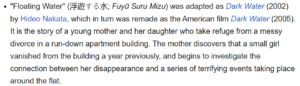
Doug’s Note: See what I mean about shared DNA but being unequal? Even the Wikipedia page for the collection seems to conflate the events from the movie and the story itself:
Yoshimi is not perfectly happy, however. She is disturbed by dirt and trash and bothered by minor incidents around the building. Her job as an proof-reader has her reading violent fiction that has left her disturbed — perhaps a self-dig for Koji Suzuki — and she is facing her own role in a line of mother-daughter relationships. Also, a strange red bag — featuring “Kitty” — keeps showing up despite her displeasure at trash and refusal to allow her daughter to play with such finds. And there is something about the water that just doesn’t feel right. Once you add in a tragedy that happened nearby, Yoshimi finds herself increasingly out of sorts with her somewhat comfortable place in life.
At the end, the reader is somewhat left to decide if there even is a haunting — I would personally lead to yes though at least 50% of the haunting is Yoshimi’s own dissonance with herself and her daughter — and to meditate on the way that past generations are caught up in the metaphor of the landfill under our feet and how they filter through.
DEEPER DIVE: “Floating Water”
HERE BE SPOILERS!
NOTE: Spoilers will not obfuscated.
There is a game that Suzuki is playing with Yoshimi and I am unsure of the precise point where speculation begins and intention begins. For instance, we learn somewhat early on that for at least three generations, with Ikuko being predicted to be the fourth, the Matsubara women have had a single child — a daughter — and that have divorced their husbands and lived on their own. Yoshimi is effectively asexual and aromantic. She does not care for the male-female dynamic. Having achieved giving birth to a daughter, she is fine with being on her own with her child.
Then, around the mid-point, we learn that she has curly auburn hair, pale skin, and freckles. Ikuko is taking after her mom and is said to have “not a trace of [her dad]’s physique.” It is as though the Matsubara women pass on near clones of themselves in layers of isolation.
We can read this on a purely practical side. Perhaps Yoshimi’s grandmother was involved — consensually or less-so — with a westerner around WW2 and this is why that generation was removed from a father figure: a pattern of trauma transmitted without precise recognition. In this, most of the haunting aspects are Yoshimi’s displacement in her own life.
Alternatively, it could be understand as something more akin to a spiritual connection. At the extreme end, the hair and skin and almost otherworldly beauty could be a nod towards a fox-wife tale. In this more spiritual reading of their family difference, this could be an explanation as to why Yoshimi is so different from others and why she and her daughter seem unique with picking up on the weird energy around the apartment building.
As for elements of the maybe-haunting, itself, there are four primary ones [excluding Yoshimi’s sense that something is wrong with the water, since this is not even confirmed by her to herself]:
- A young girl, Mitsuko Kawai, went missing around the same time the roof water tank was being cleaned.
- One night while taking a bath, Ikuko seems to be talking to someone and says the syllable “Mi.”
- A red bag with “Kitty” [i.e., Hello Kitty] on it keeps showing up in good condition even after being tossed in the trash.
- There is section with an elevator which goes up to Floor 7 and then down to Floor 2 and a sense that a chilled presence is in it (based on Yoshimi’s experiences).
#1 is definitely a horror, especially since the mom of a similarly-aged daughter lives in the building, but in itself does not qualify of a haunting. Unless we assume that writing of a disappearance in a short story is proof, enough. It is not an art form that tends to allow much extraneous detail.
#2 is faint, as faint as Yoshimi’s own sense of something being up with the water. The fact that her own name includes “mi” might hint that her daughter was talking to her mom.
#3 is actually probably the most conclusive, though nothing scary is inherent in it.
#4 is interesting, and is told in a style heavily implying that Yoshimi’s experiences are true.
It is largely the bag that makes me think we must read this as a story about a haunting1, though not necessarily of the ghostly kind. Ultimately, it does not matter if Mitsuko’s body is in the water tank. The Prologue has set up the theme of things washing up in water. The bag is the lost girl washing up upon the shore of the rooftop. Even if she is not in the tank, and Yoshimi thinks Mitsuko must be, then her disappearance is tied to that area.
Being a short story it can therefore be read as Yoshimi being 100% right. Yoshimi sees the tank as a flesh-colored coffin. A living horror. BUT, Suzuki wedges a divide between the reader and Yoshimi who does not process the world in a normal way.
The most I can say is that something is wrong with Yoshimi in that place, and it is likely Yoshimi, herself. Ikuko seems just as aware of things being different, but the daughter is enjoying herself and has no fear of the roof or the water tank. There is a jadedness in Yoshimi’s view while Ikuko experiences the otherworldly sea as a source of wonder.
- Technically we could assume it could be explained as something like Mitsuko’s parents or someone else leaving it as tribute to the girl. ↩︎