
A luxury yacht adrift at sea. When a fisherman volunteers to help see the craft back to port, he encounters the darkness which left it abandoned in the first place.
For an explanation, see 7 Days of [Koji Suzuki’s] Dark Water.
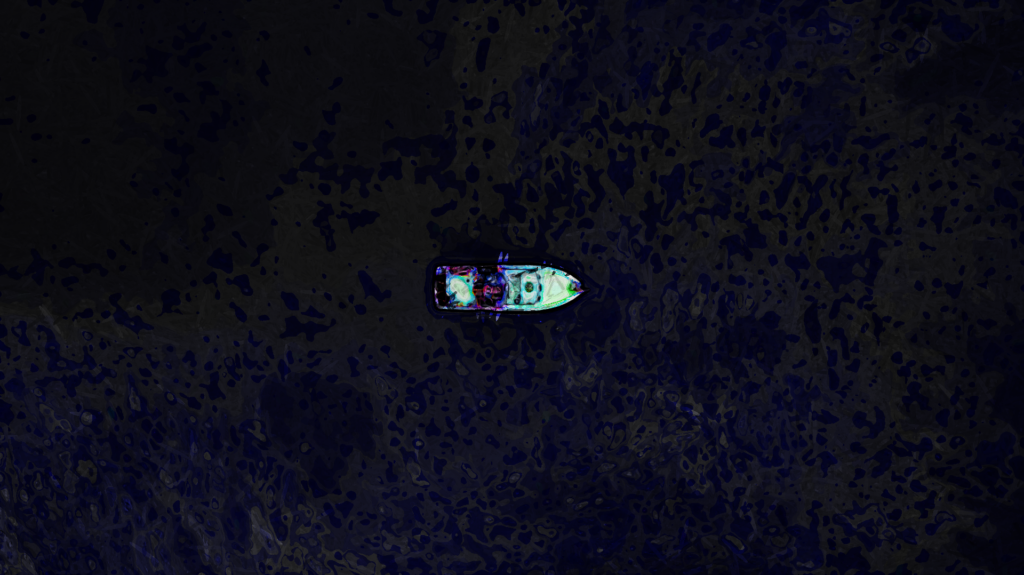
“Adrift”
The Wakashio VII is very near the end of its year-long fishing expedition. The captain and crew are only a few hours from their destination. Kazuo is both relieved and saddened. There is a chance this is his final voyage, but he looks forward to a potential new life with a new wife and family.
Only, in those final hours, the Wakashio VII comes across a luxury yacht. Expensive. Abandoned. No sign of trouble. A ghost ship of sorts. Calling out assistance, no survivors are found. The captain decides they will help tow the boat towards port, at least until the Maritime Safety Agency can take over the drifting vessel. Pulling the yacht behind will slow down progress, but the captain hopes the gesture will earn him some goodwill.
Kazuo volunteers to be on the abandoned ship. Only, while there, he comes to question fully why it was abandoned. In his exploration, he realizes there is something very dark indeed happening here.
A nice horror story that uses the legends of missing vessels and tweaks them just enough to give this one a bit of a different flavor. Walks the line between visceral and more spiritual terror quite well.
DEEPER DIVE: “Adrift”
HERE BE SPOILERS!
NOTE: Spoilers will not be obfuscated.
We see the most direct reference to the Mary Celeste so far in this collection. The infamous maritime mystery and its general trope has been referenced in nearly every story up to this point — so much so that I suspect I missed a nod to it in “Floating Water” — but in this it is not only named by name but its counterpart given. The abandoned yacht is here precisely because it is a Celeste-type event.
Note that the translator has mistakenly continued to use “Marie Celeste” instead of “Mary.”
Kazuo thinks back about how he tried solving the mystery as a kid and thus we see Koji Suzuki possibly play at the same. An explanation. One steeped in the horror genre.
In some ways, this story feels a bit different than the ones which have come before. Something in the way the details are given. The fact that we have, technically, three points of view even if Kazuo’s dominates most of the story [and there is also a bit of god’s-eye-view at the end]. The main character is not caught up in their own ego-centric struggles. While some of it deals with social awkwardness as a cousin to the horror, Kazuo and the crew of the Wakashio VII largely leap to doing the right thing. They actually alert the authorities, something woefully absent in other tales.
It almost feels like this story was more fun to write.
As is true for most of the Dark Water stories, there are questions and unknowns. We have hints of what happened to the family. Enough of a hint that we can take the story as given a bit as face value.
We lack proper knowledge of what precisely is causing the horror. We can “see” its literal, physical shape through text, but we cannot understand it. It appears to be somewhere between a shell and an eye forced into a bottle too small for it. An entity which possibly speaks in a dark, damp voice “like some message from the seabed deep below.” A terrible genie in a bottle. One who makes you wish for horrible things. Or an ancient demon of the sea. Or simply the embodiment of intrusive thoughts.
The captain of the yacht explains the dark dreams as a fear of losing your loved ones which manifests as a nightmare about killing those you love. What then of Kazuo’s nightmare about crushing crabs until he runs out and then starts crushing his own feet and legs to keep the devastation going? Does he fear dissolution of himself?
Or is the captain of the yacht wrong? Is this simply the sea doing what it does? Little crabs doomed to die against crushing rocks. People doomed to be lost when they do not understand the dangers. Maybe the thing-in-the-bottle is not so demonic or intrusive at all. Maybe it is just something like nature witnessed in its vast splendor. Destructive to people only in the way they allow it to be.
The captain’s logs, by the way, does include the hoary horror trope of a journal entry ending with, “was that a scream…” dun dun dunnn! Silly, but it works all right. I only noticed in retrospect.
The final moments is Kazuo finding himself also adrift at sea, somehow [probably self-inflicted] having become unmoored from the Wakashio VII. Rather than risk becoming another victim to the thing-in-the-bottle, he decides to set-off on a life raft. Like the story within the story, a boat adrift from a boat adrift.
Only a mistake has him bring the thing-in-the-bottle along for the ride. Our last glimpse of Kazuo is him sticking his face down into the water by the raft. “A dark, fathomless vortex was spiraling at the bottom of the night-time sea.” Kazuo gazes into the abyss and is “nearly sucked in.” Implying he survives, for a while.
Only the very next line is that he never found the thing-in-the-bottle though it was nearby. Perhaps by surviving his dreams came true and somewhere out at sea floats a man who has crushed his legs because he cannot stop? Maybe giving in is enough for you to simply disappear.
I mean, what has this whole collection been if not at least a study in people adrift in their own life at that liminal moment of change and not all of them managing to cross over?