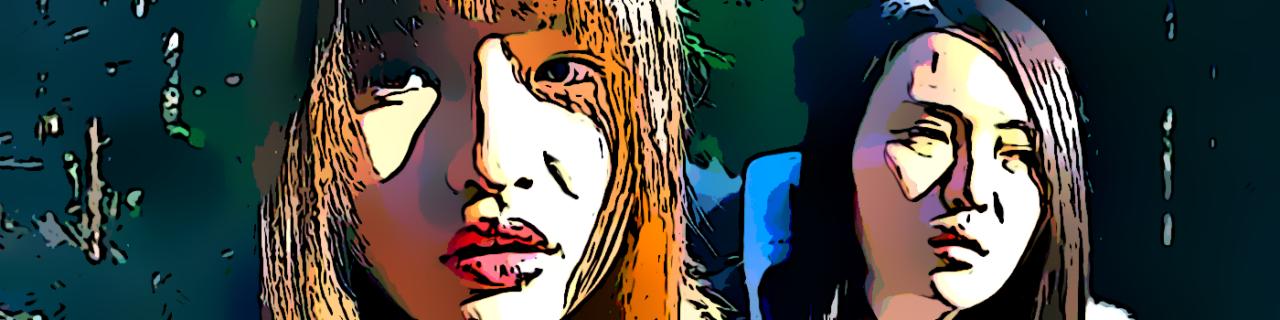
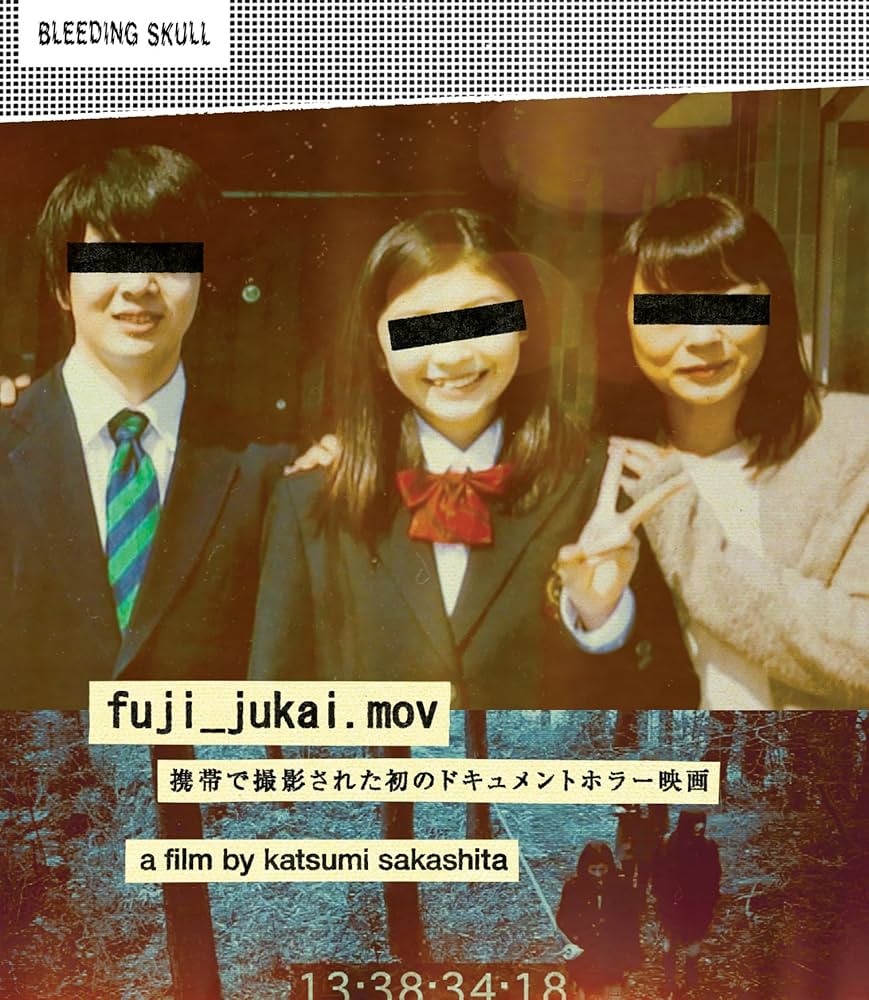
This found footage movie is very well worth a watch if you can deal with the pretty traumatic central theme of youth suicide and do not expect to play too much by standard horror tropes. Much less sensationalist than other movies that have tried to turn Aokigahara into a massive haunted house, the thoughtfulness of the interviews and carefulness of the direction (not to mention fairly strong performances by our leads) gives it a wholly different disquieting feeling than you might expect.
Summary
IMPORTANT NOTE ABOUT CONTENTS! I sometimes obfuscate content warnings because they can spoil plot points, but in this case I want to be clear: This movie is directly about SUICIDE, especially YOUTH SUICIDE, and talks about related topics like bullying, religion, isolation, near-death experiences, and feelings of worthlessness. If you are sensitive to any of that, move on from this one. It’s the core of this movie.
Ami goes into Aokigahara — the eponymous “Fuji Sea” [Fuji Jukai] — to end her life and two other teens — Mi-Tan and Hina — join her because they are interested in seeing someone die. As the three teens journey deeper into the forest, they come across shrines, bodies, and natural beauty. At the same time, various interviews with real life locals [with some fictional inserts] help to discuss how the forest and suicide impacts them.
Review: fuji_jukai.mov
NO OR VERY LIGHT SPOILERS
I watched this movie twice this week because I think it’s a movie that requires something of a fairly careful watch to actually digest. I enjoyed it both times, even knowing the twists and shifts, and if you want you can take that as all the review you need.
If you are expecting a traditional horror movie structure, you will be confused or disappointed by this film. Despite the marketing, which probably does the movie little favors.
Yes, youth suicide is pretty horrific without any embellishments but this movie is better understood as a horror-adjacent journey film with true-crime documentary elements. The processes and plot points might borrow from horror tropes, but it equally tackles the way we process grief, sensationalize death for social media, equate online success with friendship, the darker sides of childish outlooks, and the futility of reaching people who might be beyond reaching.
It has scenes of parents talking about losing children, of wives losing husbands, of unknown (and unclaimed) dead, of folks who turn to outré religion to deal with their grief, and the workers who spend hours try to save what few people they can. It also has scenes discussing the beauty of life and the beauty of the forest.
You cannot take this movie as making a singular statement. The forest is neither good nor bad. It is both holy and stained. Wild and controlled. When a inn-keeper talks about getting lost, the film is as much talking about how humans navigate their own life and the extremity of their own emotions as a physical place.
Likewise, the movie is perfect in some scenes and flawed in others. Some stage lighting and fog effects come across as too false. Most of the encounters feel properly organic [to such a degree I wonder if any of it was simply filming stuff found during the shoot], but there’s an extended segment around the 2/3s mark which feels a bit strange out of place with the rest. It is perhaps part of the movie’s multiple layers [I’ll get to it, with clearly marked spoilers, below] but here Katsumi Sakashita is allowing the film to drift too close to an honest horror movie. A needless attempt at clarity with an unclear topic even if the scenes in question are some of the most confusing.
Even to what degree the movie has the broad message of trying to live despite it all, it never feels like it condemns the victims of suicide. Likewise, despite a seemingly pro-suicide quote at the start, it for sure never condones suicide. Life, like the forest, is a complicated place to navigate. I think there is meant to be hope — a hope purposefully and ironically twisted in several ways — but hope which requires finding your way through the struggle.
I would liken the film’s plot to a katabasis [only rather than a descent into hell, we have a journey higher up into a green limbo]. As said, this is primarily a journey film and it has all the hallmarks. Strange sights. Personal reflections. And a need to keep going deeper because at the end all descents into Hell are ultimately about finding the road to Heaven on the other side.
After tribulations, of course.
This one is highly recommended by me but you have to go in and take it as is.
Shout out to Ami Ohkuma, Mirei Ohtonari, and Setsu Kohinata — yes, the three young actors seem to be using their own names, at least variations — because they navigate a very rough topic with aplomb and skill.

I especially appreciated Mirei Ohtonari’s take as Mi-Tan. While both Mi-Tan and Hina represent a look at youthful evil (I’ll leave Ami up for discussion), Ohtonari gives her character an infectious youthful ignorance. You realize pretty quickly she could be a good person if she let go of her faith in her own childishness, but also can fear she is committing a different sort of suicide. One where she destroys herself, and others around her, by trying to live up to others’ expectations of her.
Get a Copy
You can pick up a copy of fuji_jukai.mov from Vinegar Syndrome’s website.
Deeper Dive: fuji_jukai.mov
WARNING: HERE BE SPOILERS!
SPOILERS WILL NOT BE OBFUSCATED
I realized while thinking about this review that I would probably have to write a Deeper Dive to fully sum up my thoughts on it. I was sad that some basic web searching turned up so little discussion, at least in English. There are a couple of places where people review it as is, positively or negatively, but there is a missing opportunity for any kind of collective appreciation of this journey.
Ah well, Space Pilgrims, be the change you want to see in the world, no?
Let me first go back to my katabasis note — a story about a descent into Hell — and bring up a concept pretty common to literary Hells: layers and domains.
fuji_jukai.mov is definitely playing at layers. The first two are freebies.
LAYER ONE, Ami’s Suicide Journey (the shallows)
Ami is committing suicide and two jackass teens are along for the show. Along the way they see things and experience things, but this does not disrupt the journey or inform it.
We quickly come to understand Mi-Tan and Hina as two faces of evil. Mi-chan is cute and childish. She does not really care about death or suffering because she cannot comprehend it [until it directly impacts her]. We almost understand her as more evil than the nihilistic, uncaring Hina because Mi-Tan could do better if she cared more about her own thoughts than external influences.
Right as she is on the cusp of salvation, she falls back into the quagmire of her own sin by laughing at the suffering of others.
LAYER TWO (A), Ami’s (not quite) Full Journey (actually still in the shallows, maybe a bit deeper)
This is the first glance of the movie as a whole. In the twist [last chance to look away, if you wish to avoid full spoilers], we find out that Ami is not looking to die but to get revenge for her horrifically bullied brother and her fear and trepidation are less about losing her own life but instead a fear of what it means to take the lives of others. No matter what, Ami as she was will not leave the forest.
She was not upset about the livestream because it was trivializing her, but she was worried about evidence [and yes, I’ll get to *those* cameras two layers down].
You never find the same exit twice. This layer also includes the edited interviews.
LAYER TWO (B), Ami’s Mom’s (largely unknown) Journey (hidden somewhere in the depths)
We also learn that Ami’s mom has been making a similar journey and possible close enough that she has overheard many of the things and experienced the same issues. I am resisting going back over this frame by frame to try and locate how visible she might be before the reveal, but I assume she’s there a few times.
For instance, we get one of Hina’s viewers talking about a ghost behind her and Mi-Tan. Was it the mom spotted? There’s a few times you can see something move in the background.
All in all, this intersects with Layer Four, so I’ll get to it.
LAYER THREE, The Editor’s Journey (deeper and deeper)
However, while watching the movie we must ask an important question: why did the editor choose these moments? Sure, these are the highlights but our first glance of the cellphone footage is a scene of the three girls running from something which is never quite echoed in the footage we later see. There is a spot, the “actual a horror movie” spot, where it fits but it does not quite align with what we later see of that spot.
We never find out what happened to the original line being left by Ami (or why it looks a lot like a later one they follow). We never find out what “3km to paradise” means. What other sights and horrors were likewise hidden from us?
There would be something like 20-hours of footage, give or take. We are given only around an hour of the whole. One chosen to tell a particular story spliced with extra information which is placed to inform and manipulate our perception.
There is a scene around the middle where Hina starts livestreaming from the Jukai and engages in increasingly chaotic behavior as Ami tries to stop from showing up on film. Mi-chan laughs historically and hams it up for the camera at the same time. We see this, perhaps, as exploitative. Two children unable to appreciate the enormity of self-destruction while also destroying themselves in living such an external life (and this was 2016, before it got worse).
However, what about the film crew at the beginning? Are they just as bad as exploiting suicide for views? What about the movie itself? The editor, by sensationalizing the reveals — all of which would have been given in order if not for the manipulation of the scenes — has, as an adult, committed the exact same thing for which they seem to be condemning Hina.
Which brings us to…
LAYER FOUR, Ami’s ACTUAL ACTUAL Journey (deep waters)
At the end, we see Ami and her mother exit from the same path as Ami entered earlier despite the movie telling us, through editing, that one does not exit the Jukai the same way as they enter [sure, it is movie fluffery but there are rules here]. The two are joking and appreciating the beauty of the place and discussing a bath and breakfast. They discuss going back to the father/husband and having a nice day.
Ami drops her phone — it is both unclear if this was on purpose or not and what exactly she is holding in her hand that would have had the phone — and the two walk off frame. The movie then finishes it out with finishing up bits of earlier interviews which frames the forest and life not as a place of suffering and confusion but as a place of beauty and peace.
We can take from both of these that Ami has found something like peace, has now seen the forest as release.
ONLY, the phone is active evidence of her crime. By the editor finding it, and analyzing it, we can conclude that Ami and her mother are indicted for colluding in the death (? one more layer down to explain that question mark) of two others. Even outside of the phone, there are multiple security cameras that Ami and her mother walk past. They are deeply caught.
Not only that, but the framing of the movie leads us to understand that Ami attributes her seeking of revenge to suicide itself. Did Ami actually leave? Or is that Ami forever trapped and lost in those woods?
We have the conflict of these two (in film) truths. An ascent into Hell and a descent into Heaven vs the destruction of self for revenge.
This is, of course, if they actually went through with it.
LAYER FIVE, The Editor’s Actual Actual Journey (almost as deep as it gets)
A quick shot at end of the credits show Mi-Tan on the ground and we can see two figures behind her and hear what I took to be a moan and maybe she moves [or is moved by Hina?]. Is one of them still alive? The figures at a glance look like the folks from the Rebirth Village. Maybe implying that Mi-Tan will be absorbed into the horrible non-existence, cast into Limbo and liminal existence.
But, from where in the hell did the editor get THAT footage?
Sure, you could say that this footage is outside the film itself. A needless sting. That makes no sense.
If the footage is from the dropped phone then it seems more likely that Ami and her mother simply left the two injured and alone. Maybe not alone. A possible death but not a guaranteed one.
OR, perhaps, we are being told it is all lie. Of course it is, right? It’s a movie. A movie about a hard topic. The fog? The lighting? The glitches? All stage-craft.
The cursed tree with dolls before the Rebirth Village? Mi-Tan’s almost change of heart in a couple of spots right before some external force — often Hina — pulls her further in? Obviously the byproduct of a screen play which requires a certain rhythm and flow and nothing more, right?
Unless…
LAYER SIX, THE BOTTOM, Mi-Tan’s Actual Journey into Hell (the utter deep-end)
Here’s a completely out there interpretation that I was hoping some poor Youtuber would have already done (are you out there, Nightmare Movies?) but it looks like I’m the guinea pig on this one.
The most outrageous layer of the movie is asking yourself if we are seeing a true descent (ascent) into Hell. Only it’s not Ami-chan in this case. It’s Mi-Tan.
Mi-Tan is clearly the main character for most of the movie.
With the exception of a few scenes where Ami is looking directly into the camera, Mi-Tan is the primary focus of both Hina’s and Ami’s camerawork. The camera catches Mi-Tan as she kicks snow and play-acts praying. It catches her words most of all. She continues to drive the conversation forward as both Hina and Ami lapse into long silences.
It is Mi-Tan who reacts most harshly upon seeing an actual dead body. The move into the cursed tree and the Rebirth Village largely focus on her. She is the one who says that Ami must go forth into the tent and into the shed like Ami cannot enter without her permission.
Though she is often silent when confronting a third party, allowing Ami to talk, the eyes of the individuals track Mi-Tan first.
The rescuers tell us that Aokigahara is a sea of green. That when you see colors like blue and red and yellow, you know you are finding a person. Hina’s muted green jacket and green backpack [she does have a sky blue tie] and Ami’s clothing blends more into the background. Mi-tan with her brighter hair and brighter pack stands out.
Ami (supposedly) wants to die. Hina has no justification for anything besides her own boredom. It is often Mi-Tan who tries to argue reasons to stay alive even if her reasons are shallow (like getting to watch her favorite show). She is a wanderer in Hell with two Virgils. One represents self-destruction. One represents bored indifference.
Mi-Tan is the only one given the potential to change and the only one which does…
Alas, poor Mi-Tan cannot resist falling into her own pits. “I don’t want to see you die,” she says before being vetoed by Hina and then relishing in a video of her torturing a classmate. Her quiet, playful personality becoming manic when on the livestream.
In this, the fog is real (why in the flashback it seems to be gone, all of sudden). The strange multi-colored orbs in several shots are real. The odd lights are real. The shimmering nothingness of the lake (again, clearer in the flashback). The descent into night and fuzzier definition as she struggles to comprehend what she herself is doing.
The hanging clothing. The Rebirth Village with its masked people. The things slightly out of shot.
These are all Mi-Tan’s journey through Hell. She keeps saying she wants to go home but never simply turns around because the others do not seem to care. She needs others to justify herself as she moves further and further away from the civilization and crowds that give her life meaning. Her phone getting no reception is tragic for her. She’s the one who stumbles while the others seem untired. She’s the one needs the flashlight. Mi-Tan needs.
Because she is actually alone this whole time. Caught between her need of an audience and her indifference. Carrying a guilt she does not realize she feels. Being stalked by a much stronger version of that guilt out of frame.
Debating whether to kill herself because she was part of a group that drove a classmate to suicide. She is almost front and center in the video because it is not a video. It’s a memory.
At the end, she fails to either live or die.
The part of her which is indifferent is gone. The part of her that hates herself for killing Ami’s brother has moved on without her. Not even able to define herself by her sins.
Trying to solve her own Rebirth.
Whether or not she lives is up to her.