
A small acting troupe is launching a play in an old disco hall. Dripping water sends one of the crew up to investigate where he discovers something otherworldly. The most meta of the stories, and one of my favorites though the ending might irk some.
For an explanation, see 7 Days of [Koji Suzuki’s] Dark Water.
“Watercolors”
In the building which had held the multi-floor disco hall, Mephisto, a small acting troupe called the Kairin-Maru [note: the name is given like a ship’s name, something called out in the text] is putting on the most ambitious play in their history. One designed by their haughty director Kenzo Kiyohara and one of the most frenetic ex-dancers, Noriko Kikuchi.
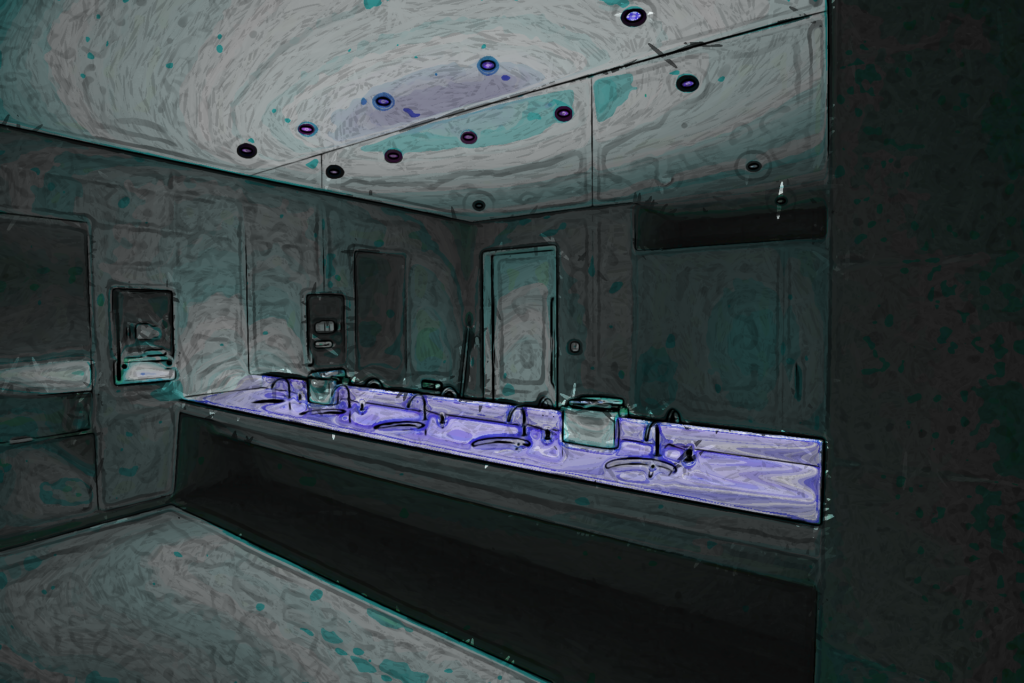
On the opening night, in the disco hall’s third floor, a water drip from the ceiling threatens to derail the play. Yuichi Kamiya, a disgraced actor working in the sound booth, goes upstairs to find the source. Here he finds a bathroom with a massive leak. Yet, as he tries to fix the leak he finds something much more otherworldly nearby.
The ending will either thrill or kill the mood, no doubt. When I first read it, it was my absolute favorite by a mile. It still holds up well, but it is very hard to discuss it without spoiling anything so I’ll pretty much jump to that.
Leaving only the note, here, that this might be the most significant story in the collection.
DEEPER DIVE: “Watercolors”
HERE BE SPOILERS!
NOTE: Spoilers will not be obfuscated.
If there was one story in this collection that I could ask Koji Suzuki about…no, strike that… if there was one tale of his at all I could ask Koji Suzuki about, it would be this one.
When I first read this collection around twenty-years ago, the story right up to the ending was my favorite thing I had read from him. It impressed me and impressed itself upon me. The ending irked me back then, and I wondered more than once about writing an inspired-by type story that tweaked the ending. Now, re-reading it: I think the ending is nearly perfect even if it does betray the story in some ways.
Let’s get spoiling!
Kamiya is sent up to fourth floor (again, the number four makes itself known) and there he finds the bathroom has a massive leak. As he tries to fix it, the situation gets worse and worse. He starts pulling out clumps of hair from the drain and tossing them to the floor. More and more. Multi-colored strands begin undulating like sea-weed in the inches-deep water.
Finally, right as he fixed the sink and unclogged the issue, as he is starting to mop the water…he realizes that one of the stalls is closed. This is a women’s bathroom with five stalls and the middle door is shut. This building has been abandoned for two years. The floor was in complete darkness. Still, the middle stall is occupied.
He goes to push upon the door and it is locked from the inside. Seconds later, someone… something… flushes. And all the water and all the hair is starting to swirl towards that stall. Then the door cracks open and Kamiya glances something… several somethings… inside.
It’s a fun moment. A perfect little horror nightmare.
Right after this, the reader is informed we are watching not Kamiya the sound booth technician but Kamiya the actor and this is part of the play. The play takes place over multiple floors. The water drips down from the fourth floor onto the play on the third. On the fourth floor, the play is about Kamiya fighting the leak and the things in the stall.
We are given the viewpoint of reviewers discussing the play, with somewhat mixed reviews, at the end. One asks why this segment was staged as a horror play. The multi-colored hair is not a ghostly visitation, but is a tribute to all the colors of hair of the people who came here to dance. Apparently there’s even a dance number after this. Amazing.
Even with this bird’s eye view, as it were, we are denied any real understand of the fifth floor. The events in the bathroom are presumably explained by the play on the fifth floor. We have perhaps a bit of a description of a large quantity of water in a massive pool, but that’s as far as we get. For that matter, we are denied the story of the third floor play. Where the water ends up.
“The subject of the play is no doubt water,” quotes the reviewer from the Monthly Play Guide. Just like the collection of short stories. Which makes this story feel like a cornerstone. A glimpse into the structure of all the stories. On a shallow reading, we see the third floor. A normal life disturbed in some way the dark water trickling down. The single mom convinced her water is tainted. The fisherman who cannot locate his wife. Another fisherman seeing an abandoned yacht.
Then, above that layer, or perhaps below, there is something stranger and darker going on. There are stalls open and closed. There is a leak from another place. As the character struggles to fix the leak, the situation gets more dire. Even at the moment of possible control, things worsen. Finally, right as the story is nearly at the end we get a flush and it all flows into a dark center.
Only in several of the stories we readers are denied the glimpse into the highest (or deepest) element. The one that truly explains and frames. What is the thing in “Adrift”? What happens afterwards in “Dream Cruise”? We do not know. Those are questions for the fifth floor and Suzuki did not take us there.
It is the Aickman technique. Construct the puzzle and then remove the center so that those who put it together must wonder what they are solving.
I love it. Others might hate it.
Before we get to the reveal, there are a few echoes worth bringing up. We get a glimpse of the Rainbow Bridge. We know somewhere beneath it is the solitary isle and its strange story.
The director, Kiyohara, turns abusive to his main star and likely lover, Noriko. One of the more baffling moments in a story that turns out to be a meta-commentary about the collection is when Kamiya excuses the somewhat violent abuse as Noriko as a sign that the her and Kiyohara must be in love. That’s right, children: only trusting couples really physically abuse one another.
And, finally, we have the perhaps overblown metaphor of the Mephisto itself. Hell stretching upward. The higher you go, the fewer clothes. The naughtier the dances. The sacred and the profane in one.
Means absolutely nothing for the plot but it’s a fun detail for a collection that tries to explore the liminal hell of deep water in all its various configurations.